Get a Quote
For Your Commercial Painting or Floor Coating Project!
Thank you! Your submission has been received!
Oops! Something went wrong while submitting the form.
X
Polyaspartic vs Epoxy Floor Coatings for Commercial Properties
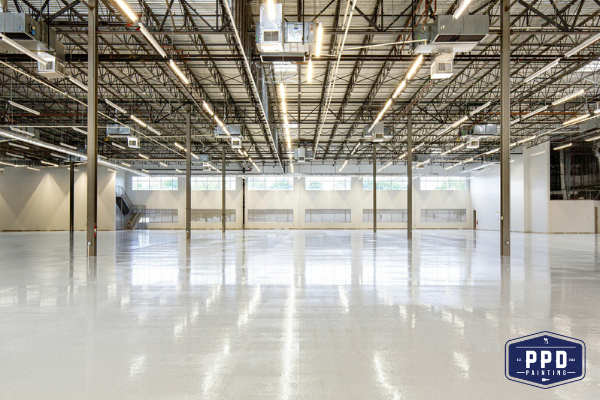
Commercial and industrial floors take a beating from daily operations. Forklift traffic, heavy equipment, chemical spills, and constant foot traffic can wear down unprotected concrete, leading to surface damage and expensive repairs. Choosing the right floor coating helps protect these surfaces while making them easier to clean and maintain.
Two common options are epoxy and polyaspartic coatings. Both provide durable protection, but they differ in curing time, UV resistance, installation requirements, and cost. For facility managers comparing polyaspartic vs epoxy, understanding these differences is important before investing in a new flooring system.
The right choice depends on how the space is used, the condition of the concrete, and how much downtime the facility can accommodate.
What Is Epoxy Floor Coating?
Epoxy is a two-component coating made from resin and a hardener. Once mixed and applied, the materials react to form a hard, protective surface that bonds to properly prepared concrete.
Commercial epoxy flooring is commonly installed in warehouses, manufacturing plants, distribution centers, maintenance facilities, and other properties that require durable floors.
One of epoxy's biggest advantages is its ability to build coating thickness. High-build epoxy systems can help create a durable surface capable of handling substantial mechanical wear. Epoxy mortar systems are particularly useful in industrial environments where heavy equipment, forklift traffic, and impacts are common.
Epoxy also offers good resistance to many chemicals, oils, and cleaning products, although the specific formulation must be selected based on the substances present.
The main disadvantage is curing time. Traditional epoxy systems may require several days before the floor can handle heavy traffic. This can create scheduling challenges for facilities that operate around the clock.
What Is Polyaspartic Floor Coating?
Polyaspartic is a type of polyurea coating known for its fast curing time, abrasion resistance, and ability to maintain its appearance under UV exposure.
Unlike traditional epoxy, certain polyaspartic systems can be ready for light foot traffic within hours of application. This makes them attractive for commercial properties where extended shutdowns are difficult or expensive.
Polyaspartic coatings are commonly used in commercial garages, retail spaces, showrooms, warehouses, and other facilities requiring a protective finish.
They are also frequently installed as a topcoat over an epoxy base. This combination provides the thickness and adhesion benefits of epoxy along with the faster curing and UV resistance of polyaspartic.
While polyaspartic offers several advantages, it typically has a higher material cost and a shorter working time during installation. Proper surface preparation and experienced application are especially important.
Polyaspartic vs Epoxy: Key Differences for Commercial Floors
Although both coatings protect concrete, their performance characteristics can affect installation schedules, maintenance needs, and overall project costs.
1. Curing Time and Facility Downtime
For many commercial property owners, curing time is one of the biggest factors in the polyaspartic vs epoxy decision.
Traditional epoxy coatings commonly require 24 to 72 hours before certain types of traffic can resume. Depending on the product and operating conditions, full curing for heavy equipment or forklift traffic may take five to seven days.
Polyaspartic coatings cure considerably faster. Some formulations allow light foot traffic within a few hours, with heavier use possible within approximately 24 to 48 hours.
Actual timelines depend on the coating system, temperature, humidity, film thickness, and manufacturer specifications.
For a warehouse operating multiple shifts, reducing downtime can be a major advantage. A faster return to service may help avoid lost production, delayed shipments, or temporary relocation of equipment.
2. Durability Under Heavy Traffic
Both epoxy and polyaspartic coatings can withstand demanding commercial environments when the system is properly specified and installed.
Epoxy is particularly effective as a high-build coating. Heavy-duty epoxy systems can provide substantial thickness and impact resistance, making them useful for manufacturing facilities and distribution centers.
Polyaspartic coatings offer excellent abrasion resistance, which can be beneficial in areas exposed to frequent foot traffic, wheeled equipment, and regular cleaning.
The best choice depends on the actual demands placed on the floor. A facility with heavy forklift traffic may benefit from a high-build epoxy system, while a commercial showroom may place greater value on abrasion resistance and appearance.
Neither coating should be selected based on material type alone. Coating thickness, concrete condition, traffic loads, and installation quality all influence performance.
3. UV Resistance and Color Retention
Sunlight exposure is another important consideration.
Traditional epoxy coatings can discolor or develop a yellow appearance after prolonged UV exposure. This can become noticeable near loading dock doors, large windows, skylights, and other areas receiving direct sunlight.
Polyaspartic coatings generally provide better UV stability and color retention.
For commercial properties where appearance matters, such as retail spaces, showrooms, and customer-facing facilities, this can be a significant advantage.
Polyaspartic topcoats can also be installed over compatible epoxy systems to help protect the finish from UV-related discoloration.
4. Chemical and Stain Resistance
Commercial floors frequently come into contact with oils, cleaning chemicals, lubricants, and other substances.
Epoxy coatings can provide strong chemical resistance, making them suitable for many industrial and manufacturing environments. Specialized formulations are available for facilities exposed to more aggressive chemicals.
Polyaspartic coatings also resist many common chemicals and stains, although their performance depends on the specific formulation.
Facility managers should identify the chemicals used or stored in the building before selecting a coating system. Concentration, exposure time, cleaning procedures, and operating temperature can all affect performance.
For facilities with significant chemical exposure, reviewing manufacturer chemical resistance data is more useful than assuming one coating is always superior.
5. Installation Requirements and Surface Preparation
Proper concrete preparation is essential for both coating types.
Before installation, the concrete must be evaluated for existing damage, contamination, moisture conditions, and previous coatings.
Surface preparation may include mechanical grinding, shot blasting, crack repair, and removal of existing coatings.
Epoxy generally provides a longer working time during application, allowing installers more time to distribute the material and achieve the required thickness.
Polyaspartic coatings cure faster, which means crews must work efficiently and follow precise application procedures.
The faster curing time does not eliminate the need for thorough preparation. Applying either coating over contaminated, damp, or poorly prepared concrete can lead to peeling, blistering, and premature coating failure.
Polyaspartic vs Epoxy Cost: Which Offers Better Value?
Epoxy generally has a lower initial material cost than polyaspartic. For large commercial projects, that difference can become significant.
Polyaspartic systems typically cost more upfront, but faster curing times can reduce the operational costs associated with closing work areas.
For example, a distribution center may face expenses from temporarily shutting down loading areas, moving inventory, or adjusting employee schedules. If a faster-curing coating reduces those interruptions, the higher installation cost may be justified.
Other factors that influence commercial floor coating costs include the square footage, concrete repairs, moisture mitigation, surface preparation, coating thickness, and number of coats required.
Property owners should evaluate the total project cost rather than comparing material prices alone. PPD Painting's commercial epoxy flooring guide provides further information on coating systems, installation costs, and project planning.
Which Floor Coating Is Best for Your Commercial Property?
The best flooring system depends on the facility's operating conditions and maintenance priorities.
Warehouses and Distribution Centers
Warehouses need flooring that can withstand pallet movement, forklift traffic, and repeated loading operations.
High-build epoxy systems are often suitable for these environments because they provide durable protection under demanding conditions.
A polyaspartic topcoat may be beneficial in areas where abrasion resistance, UV exposure, or a faster return to service is a priority.
Manufacturing and Industrial Facilities
Manufacturing plants may expose floors to heavy machinery, dropped tools, chemicals, and continuous equipment movement.
Epoxy mortar and other heavy-duty resinous flooring systems can provide the thickness and impact resistance these spaces require.
The appropriate coating should be selected based on equipment loads, chemical exposure, operating temperatures, and cleaning requirements.
Commercial Garages and Maintenance Facilities
Vehicle maintenance areas are exposed to tire traffic, oils, road salts, and frequent cleaning.
Polyaspartic coatings can be a good option for facilities requiring abrasion resistance and shorter installation schedules.
Epoxy systems are also commonly used in these environments, particularly where a thicker protective coating is needed.
Retail Spaces and Commercial Showrooms
Appearance and ease of maintenance are often priorities in customer-facing spaces.
Polyaspartic coatings offer strong UV resistance and help maintain color and gloss in areas exposed to sunlight.
Decorative epoxy systems finished with a compatible polyaspartic topcoat can also provide an attractive, durable surface.
Can You Combine Epoxy and Polyaspartic Coatings?
Yes. In many commercial applications, using both materials can provide advantages over relying on a single coating type.
A common system begins with an epoxy primer or base coat that bonds to the prepared concrete. Additional epoxy layers may be installed to build thickness or incorporate decorative aggregates.
A polyaspartic topcoat is then applied to provide abrasion resistance, UV stability, and a protective finish.
This approach can be useful for commercial garages, warehouses, showrooms, and other properties that require both substantial floor protection and a durable finished surface.
The materials must be compatible, and installers must follow the manufacturer's requirements for surface preparation, recoat windows, and curing.
Why Professional Installation Matters for Commercial Floor Coatings
Even a high-performance coating can fail if the concrete is not properly prepared or the installation conditions are unsuitable.
Moisture vapor transmission, existing surface contamination, incorrect coating thickness, and improper curing can all contribute to premature failure.
Commercial projects also require careful coordination around building operations. Equipment may need to be moved, work areas isolated, and installation schedules arranged around production or tenant activity.
An experienced commercial coating contractor can assess the concrete, review the facility's operating conditions, and recommend a system that meets the property's performance requirements.
Get Professional Commercial Floor Coating Services From PPD Painting
Choosing between polyaspartic vs epoxy coatings requires more than comparing durability and material costs. The right system must account for concrete conditions, daily traffic, chemical exposure, maintenance needs, and the time your facility can be out of service.
PPD Painting provides commercial and industrial painting and floor coating services for warehouses, manufacturing facilities, distribution centers, and other commercial properties. Our team understands the importance of proper surface preparation, coating selection, and coordinating work around active facilities.
Whether your property needs a heavy-duty epoxy flooring system, a protective topcoat, or a complete concrete floor coating project, PPD Painting can help you evaluate your options.
Contact PPD Painting today to discuss your commercial floor coating project and request an estimate.
Frequently Asked Questions
Is polyaspartic better than epoxy for high-traffic commercial floors?
Polyaspartic offers excellent abrasion resistance and faster curing, while high-build epoxy systems can provide greater thickness and impact protection. The better choice depends on the type of traffic, equipment loads, and coating system.
Can polyaspartic coatings be applied over existing epoxy floors?
Yes, compatible polyaspartic coatings can be applied over existing epoxy if the surface is properly prepared and the underlying coating is sound. The existing floor must be evaluated for adhesion, contamination, and damage before recoating.
Which coating is better for a commercial facility that cannot shut down for several days?
Polyaspartic is often preferable when minimizing downtime is a priority because many systems cure faster than traditional epoxy. Actual return-to-service times depend on the selected product and operating conditions.
About The Author

Aaron Moore
Aaron Moore is at the forefront of PPD Painting, bringing a fresh perspective and a commitment to excellence in the painting industry. With a keen eye for detail and a passion for transforming spaces, Aaron has led PPD Painting to become a trusted name in commercial and residential painting services. His approach is centered around quality, customer satisfaction, and the use of environmentally friendly paints and processes. PPD Painting is committed to not just meeting, but exceeding client expectations, offering guidance on color selection, maintenance, and the latest trends in paint technology and application.
Ratings & Reviews

"Lorem ipsum dolor sit amet, consectetur adipiscing elit. Suspendisse varius enim in eros elementum tristique. Duis cursus, mi quis viverra ornare, eros dolor interdum nulla, ut commodo diam libero vitae erat."

Name Surname
Position, Company name


Really like this service. Great pricing
Alex Wong
Well, nothing in this life seems to be perfect, but Precision Painting is nearly there.
Karen Fenyn
Very responsive. Quality work. Helpful staff!
David Wilson
Work was great. Professionally completed job. Workers were great and a pleasure thru the mess.
Kathie
Exceptional work! Ricardo did a great job. The office staff and project manager as well as Aaron were all very helpful and accommodating.
Marikay Artner
On time, professional, pleasant, hard working and thorough job.
Maura Cullen
You came here and gave us the estimate when you said you would. Your project leader was polite and on time.Your crew was here on time, they were polite and got to work right away and did a good job. The job was completed when you said it would be finished.
Joe Lambert
Very detailed, quality work, responsive, prompt, pleasant to work with.
Kurt Nitschke
First time using, but very pleased with everything. Great crew did a great job, reasonable pricing, flexible hours with minimal effect on our staff
Robert Wallace
You have experienced, professional painters who genuinely care about the quality of their work.
Ann R.
The crew was very professional and courteous.
Kim Baker
Bruno is doing a good job in his new roll as project manager and Sal is the best painter that leads the crews for Phonak work projects. I get them started and they take it from there with very little monitoring on my part. I also like the partial billing, the organizing of my paints and if possible a year end report on what we spent on patching and painting would be great.
Mike Moore
Excellent workmanship, I didn't have to check your work. Paul and Alfonso were polite, and conscientious and treated my house as if it was their own.
Rick Orna
Answered their phone promptly. Paint job was a perfect match. My customer was very pleased.
BRS
Paul is an excellent painter. He was very tidy and easy to work with. Paul did a great job matching the color of our front stain and his work is professional. Paul was on time and good at communicating. I would definitely recommend Precision Painting to a friend.
Tracy McCarville
Quality efficient work
Brent Alwood
Great Professional Work!!
James Kastanis
On time, good job, neat, good clean up
Joyce Helms
Friendly professional staff. Quick scheduling of both quote and job. Quality work at finish!
Amy Barger
On time, on budget with a high degree of quality.
Richard Dusing
Great painters did a thorough and complete job. Staff was commenting on how good they were.
John Pena
The crew did an unbelievable job on our home.
Brian Germain
By far the best team I have worked with on home improvements -- I'd describe them as professional, timely, courteous, talented, and fun!
Kevin Slattery
They were extremely professional, organized and finished the job in half the time! Highly recommend their service again :)
Valentina Labovic
Very good execution and quality.
Bob Sanner
Great company; professional and courteous. It was clear the team knew how to do their job and took pride in doing it well. Very organized and efficient as well.
Pat Shaughnessy
Always prompt, professional, reasonably priced, great work, communicates well with you!
Mary Della Chiesa
Great job and extraordinarily kind gentlemen doing the work. Had the utmost respect for our home.
Eileen Daw
Great workers and very friendly.
John Pena
PPD was professional, prompt, clean and fairly priced. Recommend 100%!
Jack Dominy
Great experience from start to finish, from scheduling the estimate, work well done, polite & professional painters, cleaned up afterward
Christine Futrell
Professional, responsive, does great work!
Kurt Nitschke
Excellent service and quality work at a fair price....
Dan Abdo
You guys do great work, are reasonably priced, and stand behind your work and all your people are good to work with. I will mention that on the last few jobs I noticed a very slight slip in the finished quality, things like drips or missed spots. No big deal but something I don't expect from you guys.
Bernard Bartelli
Terrific and conscientious quality of work plus cleanup.
John Michie
Good job and very easy to work with!
Ilsa Conover
Great friendly staff and quality painting pros.
Christine Paulson
Good job Finished on time
Pat Rossi
The work was outstanding and the employees were amazingly courteous, professional and personable.
Eva Roby
Very nice job can’t wait til do the outside
Dennis Hansen
Inspiration Gallery


