Get a Quote
For Your Commercial Painting or Floor Coating Project!
Thank you! Your submission has been received!
Oops! Something went wrong while submitting the form.
X
Warehouse Painting Cost: Dryfall, White Box, Docks, Block & Floors

SERVICE DEEP DIVE · WAREHOUSE & DISTRIBUTION
WHAT WAREHOUSE PAINTING ACTUALLY COSTS
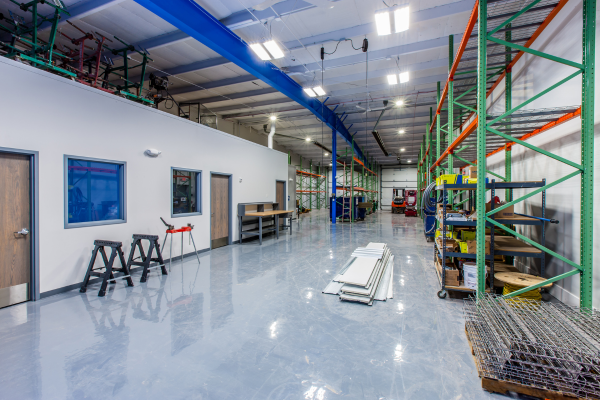
A million square feet of ceiling deck, CMU demising walls, dock doors that take a beating, and a floor that has to hold up to lift traffic — a warehouse isn't one paint job, it's six. Here's how each scope is priced, what drives the number up, and how to keep your operation running while the work gets done.
$0.80–$2.00
Ceiling dryfall, per sq. ft. of floor area
100K–1M+
Typical facility square footage
Nights & weekends
Sequenced around live operations
Est. 2003
Two decades of industrial coatings
WHAT IT COSTS AT A GLANCE
Warehouse Painting Price Ranges
Warehouse work is priced by scope, not by the building. These are realistic ranges for planning a budget — the real number depends on ceiling height, structure complexity, surface condition, and how much of your operation has to keep moving while we work.
Ceiling & structural dryfall (open deck, joists, HVAC, conduit)
$0.80 – $2.00
per sq. ft. of floor area
White box — full shell out (ceiling + walls, uniform white)
$1.75 – $4.00
per sq. ft. of floor area
CMU block & demising walls (block filler + topcoat)
$1.25 – $3.00
per sq. ft. of wall
Interior dock zones (doors, frames, impact areas, striping)
Quoted per scope
high-abuse, DTM systems
Structural columns (DTM + OSHA safety marking)
Per column / lin. ft.
prep & height dependent
Epoxy floor coatings
$3 – $12
per sq. ft. — see Epoxy Guide
READ THE FINE PRINT ON ANY BLENDED QUOTE
Anyone who quotes a whole warehouse off a single per-square-foot number without walking the deck height, checking the block, and looking at your dock condition is guessing. That's not a bid, it's a placeholder.
SECTION 01
A warehouse is six paint jobs, not one
Painting a distribution center has almost nothing in common with painting an office suite. The surfaces are different, the access is different, and the coatings are different. Before you compare a single number, understand what's actually in scope. A full warehouse repaint or fit-out typically breaks into six distinct pieces of work, each priced on its own logic:
01
Ceiling & structural steel
Open bar joists, roof decking, HVAC, sprinkler lines and conduit, usually 20–40 ft up. Sprayed with dryfall.
02
White box
Bringing a raw or dark shell up to a uniform, bright interior. Ceiling plus walls, sprayed as a system.
03
CMU & demising walls
Porous concrete block and the walls that separate bays or tenants. Needs block filler first.
04
Interior dock areas
The hardest-working square footage in the building. Doors, frames, bollards, guard rails, impact zones.
05
Columns & safety marking
Structural steel columns, often with OSHA-coded safety bases and reflective striping.
06
Floors
Epoxy or high-performance coatings that carry lift traffic, pallet jacks, and chemical exposure.
Not sure which of these your building actually needs? A walk-through tells us in an hour what a spreadsheet can't.
BOOK A SITE ASSESSMENT
SECTION 02
Ceiling & structural dryfall
If you've ever wondered how a crew sprays a 30-foot ceiling deck without coating every rack, forklift, and pallet below it in overspray — the answer is dryfall.
Dryfall (also called dry-fog or dryfall coating) is a specially formulated paint that atomizes on spray and dries to a powder before it falls a set distance — typically within 10 to 20 feet. The dry particles land on the floor as dust you sweep up, not as paint that bonds to your inventory. That's what makes it possible to coat open structure over an operating facility.
What gets coated: roof decking, bar joists, structural steel, exposed ductwork, conduit, and hangers. Ceilings are almost always sprayed white or light gray for one practical reason — reflectivity. A bright deck bounces your high-bay lighting back down, which improves light levels on the floor and can cut what you spend running fixtures.
What does NOT get coated: sprinkler heads. Painting a fire sprinkler head voids its UL listing and puts you offside with fire code — a competent crew masks every head before spraying. If a contractor doesn't mention this, that's a tell.
WHAT DRIVES THE CEILING NUMBER
Deck height (higher = more lift equipment and slower production), structural complexity (open joists and exposed mechanicals take far longer than a flat deck), existing color (going light-over-dark can mean a second coat), and whether we're working around your operation or in a cleared space.
Ceiling dryfall is quoted per square foot of floor area, not surface area — the industry convention, because the deck footprint tracks the floor. Plan on $0.80–$2.00/sq ft depending on height and complexity.
SECTION 03
White box: turning a shell into a leasable space
"White box" (sometimes "vanilla box") means taking a raw, dark, or previously-branded warehouse interior and bringing it to a clean, uniform, bright-white finish — ceiling, walls, and often exposed structure sprayed as one system.
You need it when you're prepping a spec building or a vacated bay to lease, handing a tenant a neutral space for their own fit-out, rebranding after an acquisition, or chasing better light levels and a safer, cleaner-feeling floor.
White box is the most cost-effective time to paint a warehouse, because the building is empty. No masking racks, no working around shifts, no protecting product. A cleared shell can be sprayed at production speed — which is exactly why it costs less per foot than the same work in a running facility. The paint is the cheap part. Access is what you're really paying for.
Full shell-out (ceiling + walls) runs $1.75–$4.00/sq ft of floor area depending on wall surface and clear height.
SECTION 04
CMU block & demising walls
Concrete masonry unit — CMU, or just "block" — is the most material-hungry surface in the building, and the one most often underbid.
Raw block is porous. Those open pores drink primer and paint, and if you skip the right first step you get a blotchy, pinholed finish that fails early. The correct system starts with a block filler — a high-build primer that fills the pores and creates a smooth, sealed base — followed by your topcoat. That filler coat is why block costs more than drywall per square foot: you're effectively applying an extra heavy coat before you ever put color on.
Demising walls — the walls dividing bays or tenant spaces — are usually CMU or a CMU/steel-stud hybrid, and they carry the same math. In multi-tenant buildings they also carry a branding requirement: each bay handed over clean and consistent.
DONE RIGHT — FULL BLOCK SYSTEM
- Block filler seals every pore
- Uniform, washable topcoat
- Holds up to wash-downs and abrasion
- Coats once, lasts years.
DONE CHEAP — SKIPPING THE FILLER
- Topcoat sinks into open pores
- Pinholes, blotching, early failure
- Repaint in a fraction of the time
- You pay twice.
Block with proper filler + topcoat runs $1.25–$3.00/sq ft of wall.
SECTION 05
Interior docks: the hardest-working square footage
Your dock is where the abuse lives. Dock doors, frames, levelers, bumpers, bollards, and the wall zones around them take constant impact from equipment, pallets, and weather. A standard wall coating fails here fast.
Dock areas call for direct-to-metal (DTM) and high-durability systems on the steel, plus safety marking — striping, bollard coatings, and high-visibility zones that keep foot and lift traffic separated. This is as much a safety scope as an aesthetic one.
Dock doors & framesDTM coating built for impact and cycling
Bollards & guard railsHigh-visibility safety colors
Impact wall zonesDurable, cleanable finishes
Floor striping & markingsTraffic separation, OSHA alignment
Dock zones are quoted per scope, not per square foot — condition and equipment count drive the number.
SECTION 06
Columns & safety marking
Structural columns do double duty: they hold the roof up and they organize how traffic moves on the floor. Painting them is partly protection (DTM over steel to stop corrosion) and partly safety — OSHA-aligned marking with high-visibility bases, reflective striping, and impact-warning colors so a driver sees a column before a lift finds it.
In cold-storage and wash-down environments, column coatings also have to resist moisture and cleaning chemicals, which changes the system spec. Columns are typically priced per column or per linear foot depending on height and prep.
SAFETY IS PART OF THE COATING
Reflective striping, safety-yellow bases, and clear traffic markings aren't decoration. They're how you keep people and equipment apart on a busy floor — and how you stay aligned with OSHA when someone comes to look.
SECTION 07
Floors: where coatings meet the real load
Warehouse floors carry everything — lift traffic, pallet jacks, dropped freight, chemical spills, and constant abrasion. This is a scope with its own full guide, so we'll keep it short here.
Epoxy and high-performance floor systems range widely — $3–$12/sq ft — driven by the coating type (standard epoxy vs. high-build vs. urethane topcoats), slab condition and prep, moisture mitigation, and whether you need slip resistance or chemical resistance. Prep is the make-or-break: a coating is only as good as the profile it bonds to.
RELATED GUIDEEpoxy Floor Coatings for Commercial Buildings: A Buyer's Guide
SECTION 08
Adhesion & contamination: the hidden cost driver
A coating is only as good as what it bonds to — and on a working warehouse, what it bonds to is the single most unpredictable thing in the quote. A raw shell is straightforward. But most buildings we walk into have years of operation baked into the surfaces, and that contamination decides how much prep the job needs. Prep is labor, and labor is cost — so two identical-looking buildings can quote well apart based entirely on what's on the walls and floor.
That's why we test before we price the whole building. A cross-hatch tape test (ASTM D3359) or pull-off test (ASTM D4541) on a representative area — often with a full-system test patch left to cure — tells us what prep tier the surface actually needs. That test is what turns a guess into a real number.
The prep tier is the cost. What ends up on warehouse surfaces — forklift rubber, hydraulic oil and grease, silicone and release agents, process residue soaked into block and slab, efflorescence on CMU, curing compounds and laitance on concrete, old or incompatible coatings — sorts into four cost levels:
MINIMAL — BLOW DOWN AND PAINT
Clean, sound surface with just loose dust or debris. A compressed-air blowdown clears it and we coat — no washing, effectively no added prep cost. This is the floor of the range.
LIGHT — WASH AND GO
Surface oils, scuff, or grime that needs to come off. A detergent or solvent wash handles it. A modest add to the number.
MODERATE — STRIP OR TREAT
Heavier grease, efflorescence, or a failing coating. Chemical stripping or spot treatment — a real line item, but contained.
SIGNIFICANT — MECHANICAL PREP
When the contamination is in the surface, not just on it: diamond grinding or shot blasting floors, abrasive blasting steel, plus a bonding primer. The biggest prep cost there is — occasionally more than the coating itself.
WHY THE CHEAPEST BID IS OFTEN THE ONE THAT SKIPPED THIS
When one quote comes in dramatically low, it usually assumed the blow-down tier and didn't test for what's underneath. Painting over contamination looks like savings on day one and becomes a peeling, delaminating warranty claim by month six. Testing up front is how we protect the coating — and how we make sure the number you approve is the number the job actually needs.
Why Is My Commercial Paint Peeling?
SECTION 09
What actually moves the number
Two identical-looking buildings can quote very differently. Here's what separates them:
01
Clear height
A 40-ft deck needs bigger lifts and slower, safer production than a 24-ft deck. Height is the single biggest ceiling-cost driver.
02
Occupied vs. empty
An empty shell sprays at production speed. A live facility means masking, phasing, night and weekend shifts, and protecting product. Access, not paint, is the cost.
03
Surface condition & prep
Flaking coatings, rust on steel, or contaminated block all add prep hours — and contamination that requires stripping or mechanical prep is the biggest prep-cost swing there is. Prep is where longevity is won or lost.
04
Coating system
Dryfall, block filler, DTM, and epoxy are different products at different price points. The right system is spec'd to the surface, not to the cheapest gallon.
05
Square footage
Warehouses reward scale. The bigger the clean, continuous area, the lower the effective per-foot rate.
Get a scoped warehouse quote. We walk the deck height, check the block, and look at your dock condition before a number ever leaves our mouth.
REQUEST A SITE ASSESSMENT
SECTION 10
Keeping your operation running
The question every facility director actually asks: can you do this without shutting me down?
Usually, yes. Most warehouse work is sequenced around live operations — sectioning off zones, running nights and weekends, coating one bay or aisle at a time, and protecting racking and product as we go. Dryfall exists precisely so overhead work can happen above a functioning floor. The plan is built around your throughput, not ours.
WHAT GOOD SCHEDULING LOOKS LIKE
A phased plan that names which zones get coated when, what has to be cleared, and how we protect what stays. You should know the sequence before the first sprayer is uncapped. If a contractor can't give you that, they haven't thought about your operation.
CASE STUDY
See it on a real facility
The scopes, sequencing, and prep decisions in this guide aren't theoretical — they're how the work actually gets done on a live building. For a look at PPD on a real project, see our case study on the Solventum facility in Brookings, SD.
READ THE FULL CASE STUDYSolventum — Brookings, SD
FAQ
Warehouse painting cost: common questions
Ceiling dryfall typically runs $0.80–$2.00 per square foot of floor area, driven mainly by clear height and structural complexity. A 40-ft open-joist deck costs more per foot than a 24-ft flat deck because of the lift equipment and slower production.
Height and structure drive the ceiling number more than square footage does.
Dryfall is a coating that dries to a powder before it falls a set distance — usually 10–20 feet — so overspray lands as sweepable dust instead of bonding to floors, racking, or inventory. That's what makes it possible to coat open ceilings and structural steel over a working facility.
It's the reason overhead work can happen above a running floor.
Block is porous and requires a block-filler primer to seal the pores before the topcoat goes on. That filler is effectively an extra heavy coat, so you're paying for more material and more labor per square foot. Skip it and the finish pinholes and fails early.
The filler coat is non-negotiable — it's why block runs $1.25–$3.00/sq ft.
In most cases, yes. Work is phased around live operations — zone by zone, nights and weekends, with racking and product protected. Dryfall specifically enables overhead work above an active floor.
A good contractor plans the sequence around your throughput before starting.
A white box brings a raw or dark shell to a uniform bright-white finish — ceiling and walls sprayed as one system, usually in an empty building. A repaint addresses specific worn or damaged surfaces in an occupied facility. White box is cheaper per foot because the space is clear and can be sprayed at speed.
Empty and uniform is always the cheapest time to paint.
Years of operation leave contaminants — oils, grease, release agents, process residue, efflorescence — that stop paint from bonding no matter how good the product is. An adhesion test (cross-hatch tape per ASTM D3359 or pull-off per ASTM D4541) on a representative area tells us how much prep the surface actually needs, and prep is one of the biggest cost swings in the job — from a simple blow-down at the low end to diamond grinding or abrasive blasting at the high end.
Testing up front is how the number you approve becomes the number the job actually needs.
EXPERIENCE MATTERS
Your warehouse isn't a guess. Your quote shouldn't be either.
From dryfall ceilings to epoxy floors, we scope every surface before we price it — and we sequence the work around your operation, not the other way around.
About The Author

Aaron Moore
Aaron Moore is at the forefront of PPD Painting, bringing a fresh perspective and a commitment to excellence in the painting industry. With a keen eye for detail and a passion for transforming spaces, Aaron has led PPD Painting to become a trusted name in commercial and residential painting services. His approach is centered around quality, customer satisfaction, and the use of environmentally friendly paints and processes. PPD Painting is committed to not just meeting, but exceeding client expectations, offering guidance on color selection, maintenance, and the latest trends in paint technology and application.
Ratings & Reviews

"Lorem ipsum dolor sit amet, consectetur adipiscing elit. Suspendisse varius enim in eros elementum tristique. Duis cursus, mi quis viverra ornare, eros dolor interdum nulla, ut commodo diam libero vitae erat."

Name Surname
Position, Company name


Really like this service. Great pricing
Alex Wong
Well, nothing in this life seems to be perfect, but Precision Painting is nearly there.
Karen Fenyn
Very responsive. Quality work. Helpful staff!
David Wilson
Work was great. Professionally completed job. Workers were great and a pleasure thru the mess.
Kathie
Exceptional work! Ricardo did a great job. The office staff and project manager as well as Aaron were all very helpful and accommodating.
Marikay Artner
On time, professional, pleasant, hard working and thorough job.
Maura Cullen
You came here and gave us the estimate when you said you would. Your project leader was polite and on time.Your crew was here on time, they were polite and got to work right away and did a good job. The job was completed when you said it would be finished.
Joe Lambert
Very detailed, quality work, responsive, prompt, pleasant to work with.
Kurt Nitschke
First time using, but very pleased with everything. Great crew did a great job, reasonable pricing, flexible hours with minimal effect on our staff
Robert Wallace
You have experienced, professional painters who genuinely care about the quality of their work.
Ann R.
The crew was very professional and courteous.
Kim Baker
Bruno is doing a good job in his new roll as project manager and Sal is the best painter that leads the crews for Phonak work projects. I get them started and they take it from there with very little monitoring on my part. I also like the partial billing, the organizing of my paints and if possible a year end report on what we spent on patching and painting would be great.
Mike Moore
Excellent workmanship, I didn't have to check your work. Paul and Alfonso were polite, and conscientious and treated my house as if it was their own.
Rick Orna
Answered their phone promptly. Paint job was a perfect match. My customer was very pleased.
BRS
Paul is an excellent painter. He was very tidy and easy to work with. Paul did a great job matching the color of our front stain and his work is professional. Paul was on time and good at communicating. I would definitely recommend Precision Painting to a friend.
Tracy McCarville
Quality efficient work
Brent Alwood
Great Professional Work!!
James Kastanis
On time, good job, neat, good clean up
Joyce Helms
Friendly professional staff. Quick scheduling of both quote and job. Quality work at finish!
Amy Barger
On time, on budget with a high degree of quality.
Richard Dusing
Great painters did a thorough and complete job. Staff was commenting on how good they were.
John Pena
The crew did an unbelievable job on our home.
Brian Germain
By far the best team I have worked with on home improvements -- I'd describe them as professional, timely, courteous, talented, and fun!
Kevin Slattery
They were extremely professional, organized and finished the job in half the time! Highly recommend their service again :)
Valentina Labovic
Very good execution and quality.
Bob Sanner
Great company; professional and courteous. It was clear the team knew how to do their job and took pride in doing it well. Very organized and efficient as well.
Pat Shaughnessy
Always prompt, professional, reasonably priced, great work, communicates well with you!
Mary Della Chiesa
Great job and extraordinarily kind gentlemen doing the work. Had the utmost respect for our home.
Eileen Daw
Great workers and very friendly.
John Pena
PPD was professional, prompt, clean and fairly priced. Recommend 100%!
Jack Dominy
Great experience from start to finish, from scheduling the estimate, work well done, polite & professional painters, cleaned up afterward
Christine Futrell
Professional, responsive, does great work!
Kurt Nitschke
Excellent service and quality work at a fair price....
Dan Abdo
You guys do great work, are reasonably priced, and stand behind your work and all your people are good to work with. I will mention that on the last few jobs I noticed a very slight slip in the finished quality, things like drips or missed spots. No big deal but something I don't expect from you guys.
Bernard Bartelli
Terrific and conscientious quality of work plus cleanup.
John Michie
Good job and very easy to work with!
Ilsa Conover
Great friendly staff and quality painting pros.
Christine Paulson
Good job Finished on time
Pat Rossi
The work was outstanding and the employees were amazingly courteous, professional and personable.
Eva Roby
Very nice job can’t wait til do the outside
Dennis Hansen
Inspiration Gallery


