Epoxy Floor Coatings for Commercial Buildings: A Buyer's Guide
Cost, coating systems, bid evaluation, and what separates a properly specified floor from one that fails at the joints in 18 months.
By Aaron Moore, President · PPD Painting · June 2026
The Short Answer
Commercial epoxy flooring runs $3 to $12 per square foot installed, depending on substrate condition, coating system, and square footage. A 10,000 sq. ft. warehouse floor typically lands between $30,000 and $80,000. That range isn't vague — it reflects real variables that every buyer should understand before they request a quote.
This guide covers what drives cost, what coating systems actually exist, how to read a spec, and what to watch for when comparing bids.
A standard 2-coat epoxy on a clean, prepped slab and an epoxy mortar system on a contaminated, moisture-compromised floor are not the same job. The substrate dictates as much of the final price as the coating system itself.
What Is Commercial Epoxy Flooring?
Epoxy isn't a single product — it's a category. The term covers several distinct coating systems that share a common chemistry (resin + hardener) but differ significantly in thickness, performance, and cost. What a residential big-box store sells in a kit and what a commercial contractor installs in a distribution center are not the same thing.
For commercial and industrial buyers, the relevant systems are:
Epoxy Coating (Standard)
A 2-part epoxy applied at 10–15 mils DFT (dry film thickness). Chemical resistant, cleanable, appropriate for light-to-medium traffic. Common in retail storage, light manufacturing, office back-of-house.
Epoxy Mortar (Heavy-Duty)
Epoxy binder mixed with graded aggregate. Builds up to 1/4" thick. Handles heavy forklift traffic, thermal cycling, and mechanical impact. The right spec for distribution centers, cold storage facilities, and food processing.
MMA (Methyl Methacrylate)
Fast-cure system — back in service in 2–3 hours. Higher cost. Used where downtime is genuinely not an option: hospitals, food production, 24/7 operations.
Polyaspartic / Polyurea Topcoats
Often applied over epoxy base coats as a UV-stable, abrasion-resistant finish layer. Extends system life. Common on exterior-exposed slabs and areas with high foot traffic.
Broadcast Flake or Quartz Systems
Decorative aggregate — color flake or quartz — broadcast into a wet epoxy base coat, then sealed with a clear polyaspartic or polyurethane topcoat. The sealer is what gives the system its gloss, chemical resistance, and cleanability; the broadcast layer provides texture, slip resistance, and aesthetics. Standard spec for office lobbies, showrooms, fitness centers, and light commercial applications. Durable in the right environment — not rated for heavy forklift traffic.
A clear sealer-only system (no color coat, no broadcast) is also a common spec for existing concrete that just needs protection and gloss. Lower cost, faster installation, same sealer chemistry.
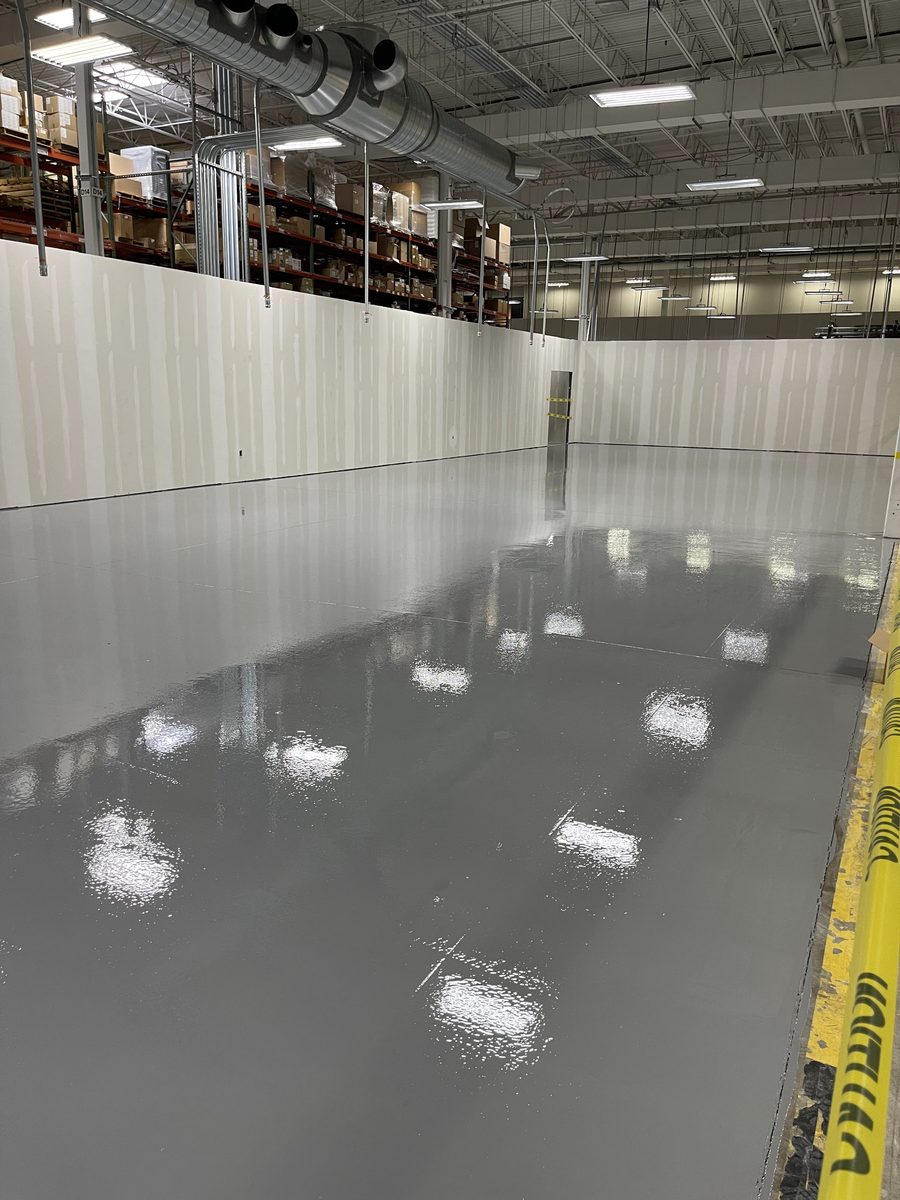
Metallic Epoxy
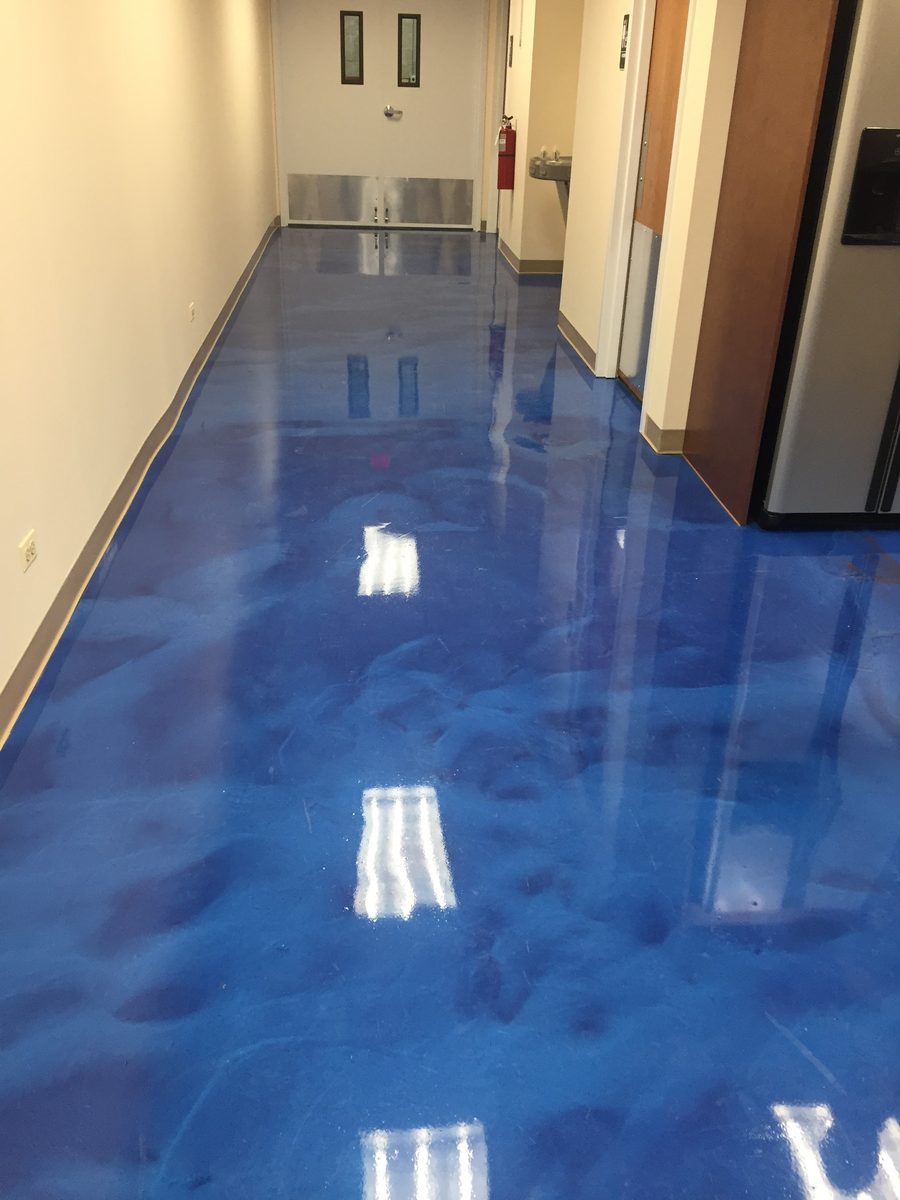
Metallic pigment or mica flakes suspended in a clear epoxy base, creating a distinctive swirled, three-dimensional appearance. Genuinely commercial-grade despite the decorative finish — two-part chemistry, same prep requirements, same durability profile as standard epoxy. Common in corporate lobbies, upscale showrooms, fitness facilities, and high-end retail. Priced at $7.50–$12+ per square foot depending on complexity of the metallic effect and topcoat system. Not appropriate for heavy forklift traffic — the metallic layer is not rated for that abuse.
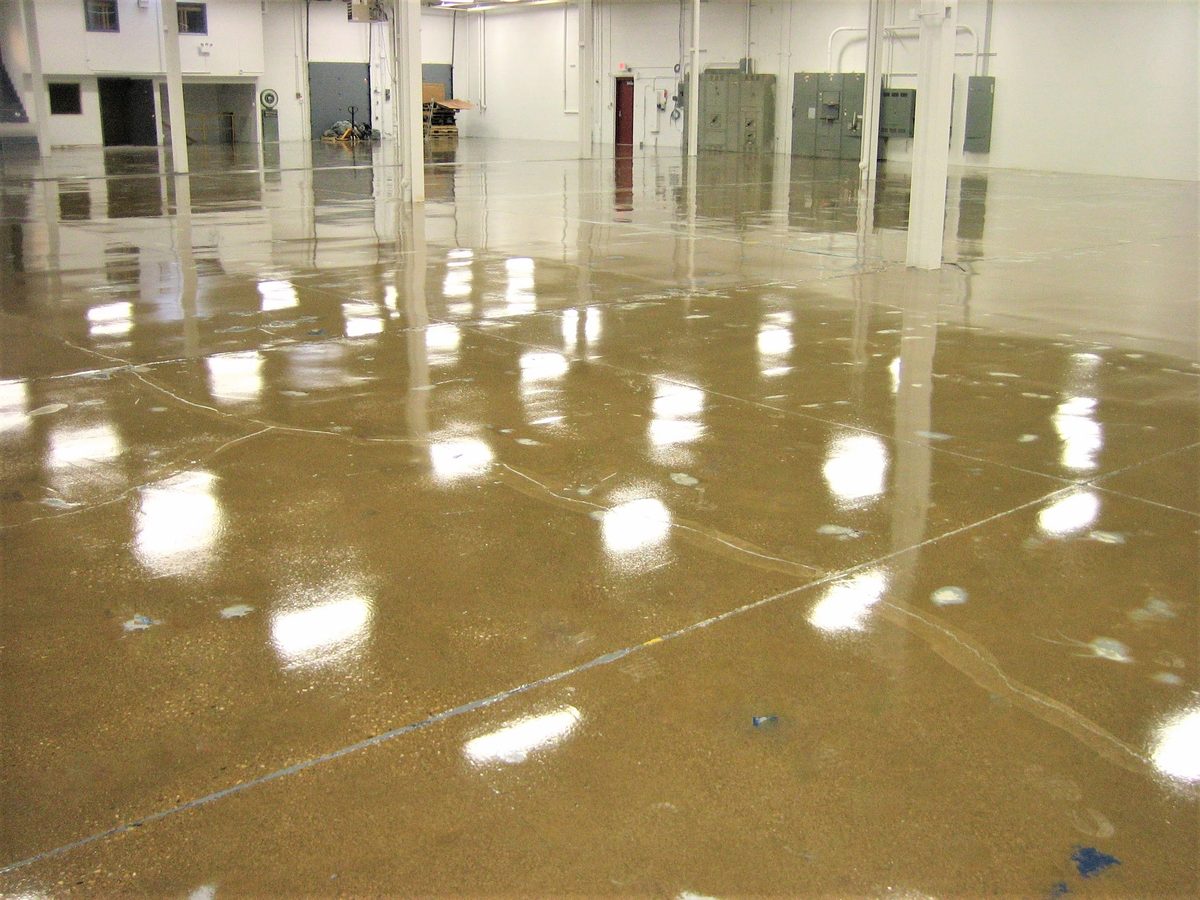
Clear Coats and Sealer-Only Systems
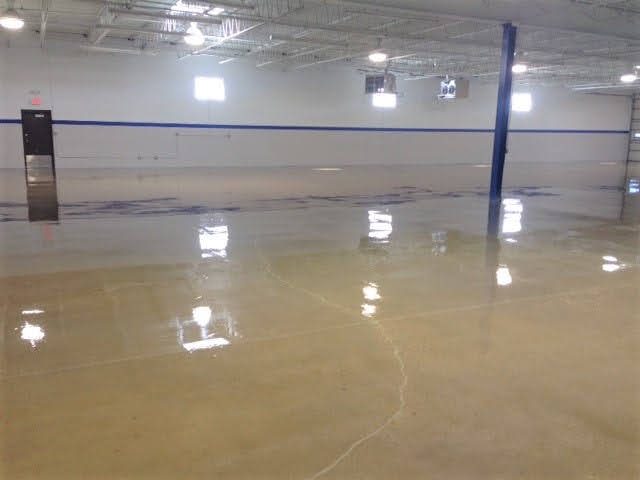
A clear sealer system is exactly what it sounds like: no color coat, no broadcast aggregate — just a penetrating or film-forming sealer applied directly to bare or existing concrete. It's the right spec for facilities that want concrete protection, improved cleanability, and a professional gloss finish without changing the floor's appearance dramatically.
Clear sealers use the same two-part chemistry as colored epoxy systems — polyaspartic, polyurethane, or straight epoxy — so durability is real. The difference is what's underneath: raw concrete texture and color show through. That can be a feature (natural look, existing floor preserved) or a limitation (stains, patches, and variation in the concrete will still be visible).
Common applications: distribution centers and warehouses wanting cleanability and gloss without a full coating system, existing broadcast floors needing a topcoat refresh, food service areas requiring a seamless, chemical-resistant surface without color change, and any facility where a clear sealer was spec'd on new construction.
The one thing that doesn't change with a clear sealer: prep. Shot blasting or diamond grinding the concrete is still required. The sealer bonds to the slab the same way a colored epoxy does — skip prep and the sealer fails the same way. A cheap "clear sealer" bid that doesn't include surface profile prep is not a sealer system, it's a floor wax.
What Drives the Cost
Substrate Condition
This is the biggest variable in any epoxy quote. Concrete that's been neglected — cracked, oil-contaminated, moisture-compromised — requires significantly more prep work before a coating can bond. Shot blasting, crack repair, moisture mitigation, and etch cleaning are all priced separately from the coating itself. If a quote doesn't break out surface prep as a line item, ask why.
Coating System Specified
A standard 2-coat epoxy system at 15 mils is priced differently than a broadcast flake system with a polyaspartic topcoat, which is priced differently than an epoxy mortar system designed for forklift traffic. Make sure you're comparing the same spec across competing bids — not just a per-square-foot number.
Square Footage and Site Access
Larger projects benefit from economies of scale: setup, mobilization, and equipment costs are spread across more square footage. A 5,000 sq. ft. floor will cost more per square foot than a 50,000 sq. ft. floor with equivalent prep requirements. Site access — loading dock availability, operational hours, whether the facility needs to stay partially active — also affects crew efficiency and cost.
Cure Time and Scheduling Constraints
Standard epoxy requires 24–72 hours cure time before light traffic and 5–7 days before full forklift loads. If your facility can't accommodate that window, you're looking at MMA or polyaspartic systems that cure faster — and cost more. Know your downtime tolerance before you spec.
Region and Market
Labor costs vary by market. Cincinnati, Indianapolis, and Chicago are meaningfully different from rural markets in terms of crew rates. Factor that in when evaluating national bids.
How to Read a Commercial Epoxy Bid
Most buyers receive 2–3 quotes on a floor project and default to the lowest number. That's a reasonable instinct, but it's the wrong filter for flooring.
- Surface prep itemized with scope defined
- DFT specified per coat and in total
- Recoat window and cure schedule stated
- Workmanship and material warranty terms
- Applicator certifications and project references
- Manufacturer and product line named
- "Surface prep included" with no scope detail
- No DFT or mil thickness specified
- No cure schedule or traffic timeline
- Warranty terms vague or absent
- No manufacturer or product line named
- Lowest number by a significant margin
Common Failures — and What Causes Them
Most epoxy failures trace back to one of three root causes:
Adhesion Failure (Peeling, Delamination)
Almost always a surface prep issue. Contamination, moisture, or inadequate profile on the concrete surface. The coating didn't fail — the prep did.
Bubbling or Pinholes
Outgassing from concrete — moisture vapor transmitting through the slab, creating bubbles in a freshly applied coat. Requires moisture testing before application and, in high-MVT environments, a moisture mitigation primer.
Premature Wear or Scratching
Usually a mismatch between the specified system and the actual use. A decorative broadcast floor is not rated for heavy forklift traffic. Spec to your actual load and traffic — not just aesthetics.
All three failure modes are preventable. They're the result of inadequate assessment before the job starts — not the chemistry of epoxy itself. A contractor who skips moisture testing and substrate profiling to save time is pricing in your future problem.
What the Scope of Work Should Include
A complete commercial epoxy installation includes more than the coating itself. A proper scope covers:
- Moisture vapor transmission (MVT) testing
- Shot blasting or diamond grinding to ICRI CSP 3–5 profile
- Crack and joint repair
- Primer coat (moisture-blocking or standard depending on MVT results)
- Base coat(s) at specified DFT
- Broadcast layer if decorative system
- Topcoat / sealer
- Cove base at wall transitions (if specified)
- Post-installation inspection and punch list
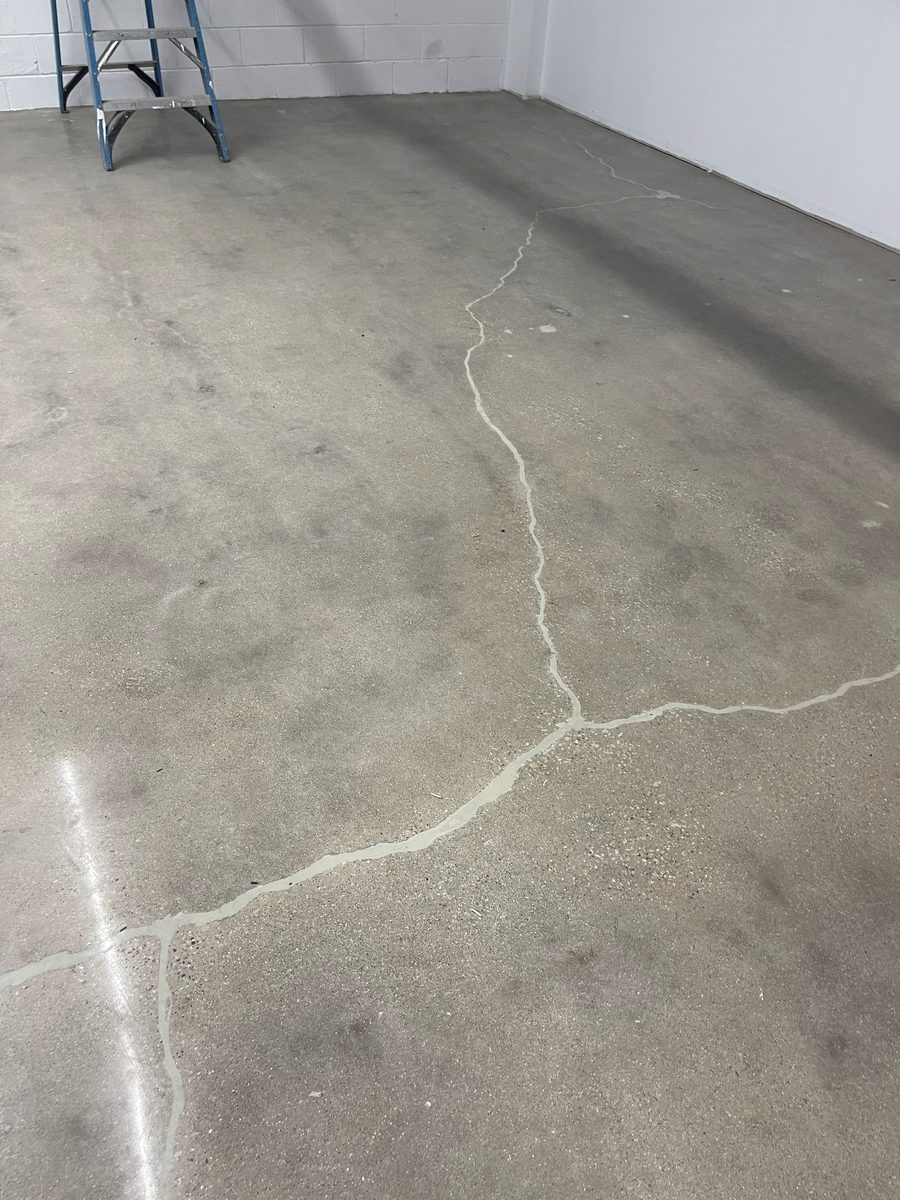
If a proposal doesn't address all of these, ask what's excluded and why.
Food Service and Manufacturing: A Different Spec Entirely
Commercial kitchens, food processing facilities, and pharmaceutical manufacturing environments have requirements that standard epoxy systems weren't designed to meet. If your facility involves food handling, wet processing, steam cleaning, or chemical wash-downs, the coating conversation starts in a different place.
Urethane Cement — The Right Call for Food Service
Standard epoxy is not the preferred system for commercial kitchens and food processing floors. The reason is thermal shock — the rapid temperature cycling between hot wash-down water, steam cleaning, and refrigerated zones causes standard epoxy to delaminate over time. Urethane cement (also called urethane mortar) handles thermal shock significantly better, resists the organic acids and fats common in food environments, and maintains bond integrity through aggressive sanitation protocols. It costs more than standard epoxy — typically $8–$14 per square foot installed — but it's the correct specification for the environment. Installing standard epoxy in a food service facility to save money is a short-term decision with a predictable outcome.
Integral Cove Base — The Sanitary Detail That Matters
In food processing, commercial kitchens, and pharmaceutical facilities, the 90-degree joint where the floor meets the wall is a critical hygiene failure point. Grease, bacteria, and moisture collect in that corner and are nearly impossible to clean completely. The correct solution is an integral cove base — the floor coating material is turned up the wall 4 to 6 inches in a continuous curved profile, eliminating the corner joint entirely. This detail is required by health codes in most commercial food service environments and is considered standard practice in any facility subject to sanitation inspection. It is not an upgrade — it is a baseline spec requirement. Any contractor quoting a food service floor without including integral cove base detail is not giving you a complete scope.
Seamless, Monolithic Floor Systems
Food processing and pharmaceutical facilities require floors with no joints, no seams, and no gaps where contamination can harbor. A properly installed trowel-applied urethane cement or high-build epoxy mortar system, with integral cove base at all wall transitions and sealed penetrations at drains and equipment bases, creates a fully monolithic surface. This is the specification that passes health department and third-party food safety audits. It is also significantly more expensive to install correctly than a standard warehouse epoxy — and significantly less expensive than a failed audit or a product recall.
Urethane cement or urethane mortar system · Integral cove base at all wall transitions · Sealed floor penetrations at drains and equipment bases · Thermal shock-rated system · NSF or USDA-compliant coating materials · Slip-resistance rating appropriate for wet environment
Floor Marking and Safety Striping
Floor marking is frequently treated as an afterthought — something added at the end of a coating project or deferred until OSHA compliance becomes a more pressing concern. In practice, a well-executed floor marking program is one of the highest-ROI investments a warehouse or distribution center can make, and it's often a standalone project that doesn't require a full floor recoat.
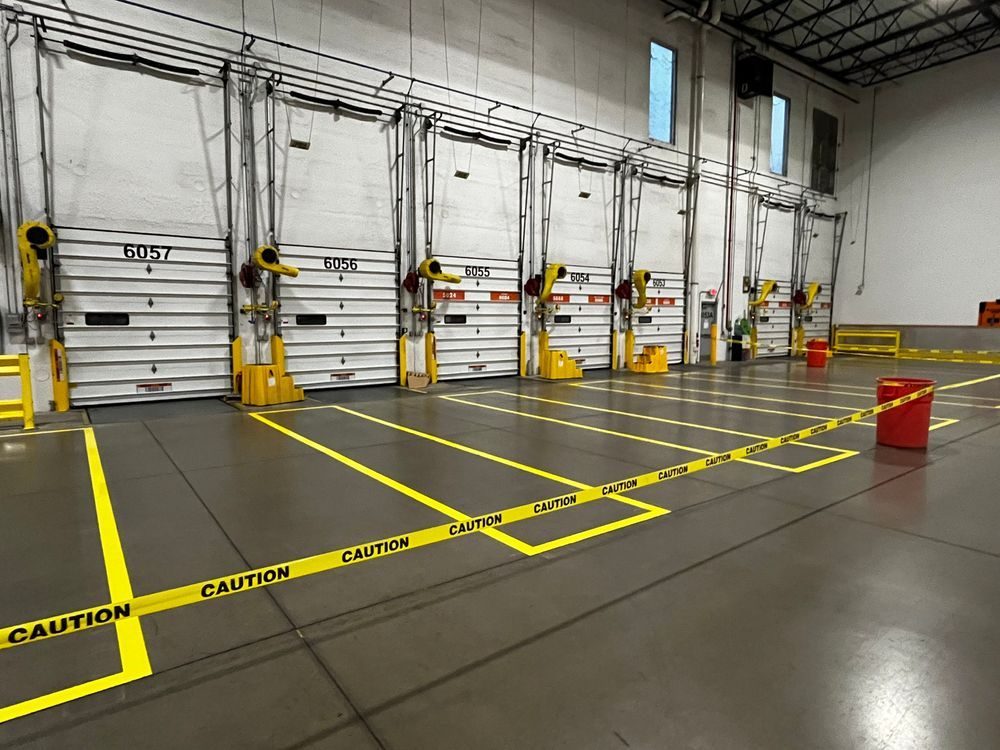
What Floor Marking Covers
A complete warehouse floor marking system typically includes forklift traffic lanes and pedestrian walkways, loading dock delineation and staging zones, rack row identification, hazard striping at columns, doors, and overhead obstructions, fire safety equipment locations, and ADA-compliant accessible route marking. OSHA 1910.22 requires that walking-working surfaces be kept clear and that permanent aisles and passageways be appropriately marked — which means this isn't optional in any facility with forklift traffic.
Standalone Striping Projects
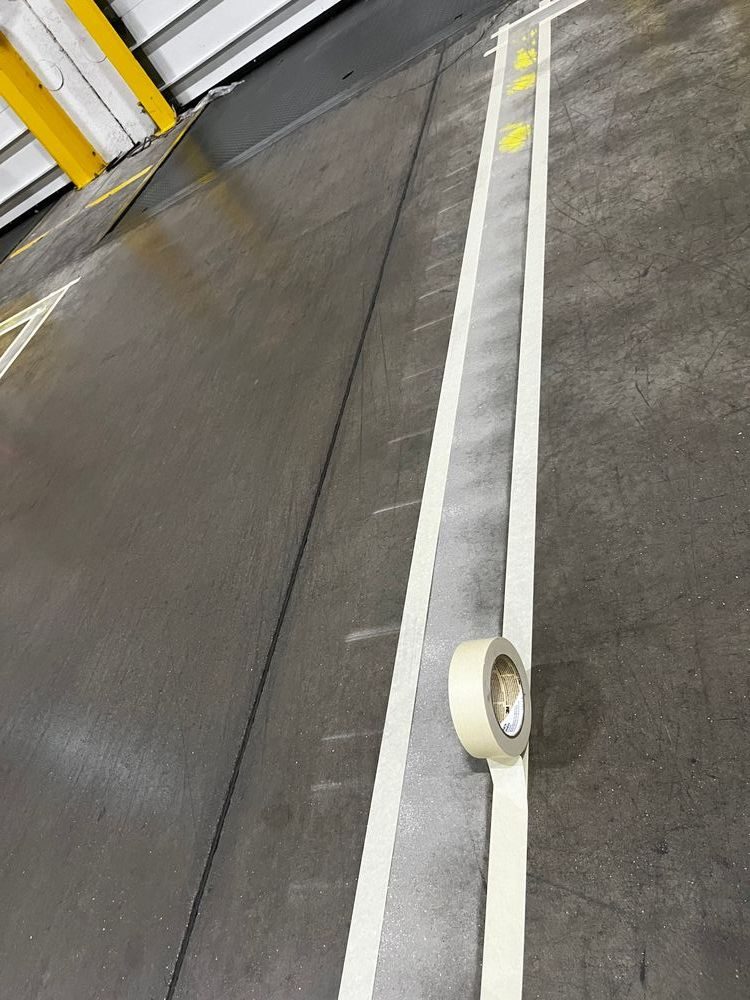
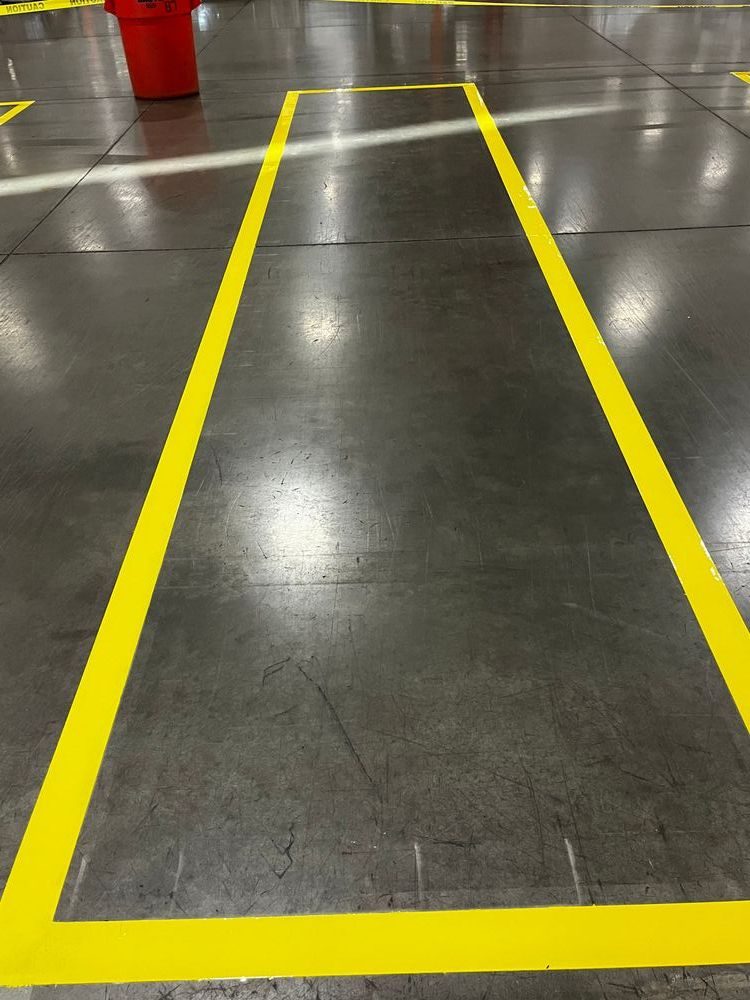
Floor marking doesn't require a full epoxy system. Traffic-grade floor marking paint or epoxy-based line paint applied to a clean, properly prepped concrete surface holds up well in most warehouse environments. For facilities with existing coated floors, solvent-free marking systems bond effectively to cured epoxy. Typical standalone striping projects for a 50,000–100,000 sq. ft. distribution center run $8,000–$25,000 depending on complexity of the layout, number of colors, and surface condition. That's a fraction of a full floor recoat — and often the first project that opens the door to a longer maintenance relationship.
Thermoplastic and Epoxy Marking Systems
Standard floor marking paint is appropriate for light-to-medium traffic. Facilities with heavy forklift traffic — particularly counterbalanced lifts with solid pneumatic tires — will wear through standard marking paint quickly at turn points and high-frequency lanes. Epoxy-based marking systems or thermoplastic tape provide significantly better durability in those environments and are worth the additional cost on high-traffic lanes, even if standard paint is adequate for pedestrian walkways.
Epoxy vs. Polished Concrete vs. VCT
Epoxy
Best combination of chemical resistance, cleanability, and durability for most commercial applications. Higher upfront cost than VCT, lower than full polished concrete. Requires periodic recoating (7–15 years depending on traffic).
Polished Concrete
Durable, attractive, zero coating to fail. Requires densifier application and periodic re-polishing. Higher initial cost on rough slabs, competitive on already-smooth concrete. No chemical resistance without topcoat.
VCT (Vinyl Composition Tile)
Low upfront cost, easy to replace individual tiles. Requires regular waxing and stripping program. Not appropriate for wet areas, heavy traffic, or chemical exposure. Total cost of ownership over 10 years often exceeds epoxy.
Why It Matters Who Applies It
Epoxy is a performance product. The chemistry is only as good as the applicator's preparation, mixing ratios, and application technique. Manufacturer training, project references, and crew experience aren't marketing — they're quality indicators.
PPD Painting has been applying commercial floor coatings since 2003. We work with facility directors and operations managers who need a floor that holds up — not one that looks good for six months and starts peeling at the joints. We specify systems to match actual use conditions, price surface prep honestly, and stand behind the work.
Sometimes we're the lowest bid. Sometimes we're not. What we can promise is that we'll always be the best bid — and the best bid means the right coating system for your substrate, surface prep that's priced honestly and not buried in the fine print, a crew that shows up when they say they will, and a scope of work you can actually hold someone to. That's what you're buying.
If you're evaluating epoxy bids for a warehouse, distribution center, or commercial facility in Chicago, Indianapolis, Cincinnati, or Bozeman, we're happy to walk through the spec with you before you commit to anything.
Frequently Asked Questions
A properly specified and installed epoxy system in a commercial setting typically lasts 7–15 years before requiring recoating. Heavy forklift traffic, chemical exposure, and thermal cycling shorten that. Light commercial environments with periodic maintenance can exceed 15 years.
Spec to your actual use conditions — not the lowest-traffic scenario.Yes, with proper prep. The existing surface needs to be abraded to provide mechanical adhesion for the new coat. If the existing coating is delaminating or contaminated, it typically needs to be removed before recoating. A good contractor will assess and tell you which situation you're in.
Standard epoxy: 24 hours for foot traffic, 72 hours for vehicles, 5–7 days for full forklift loads. Fast-cure MMA systems can be back in service in 2–3 hours.
If downtime is a major constraint, discuss MMA or polyaspartic options during estimating — not after the contract is signed.Yes, but the system needs to be specified for that environment. Cold storage requires a coating with adequate flexibility to handle thermal cycling between ambient and low temperatures. Standard epoxy can crack at temperature extremes. Discuss the operating temperature range with your contractor before spec is finalized.
Polyurea and polyaspartic are different chemistries often used as topcoats over an epoxy base. They cure faster, are more UV-stable, and resist abrasion well — but they're typically not used as standalone floor systems in heavy commercial applications. In most cases, the best-performing floor uses epoxy for the base and polyaspartic for the finish coat.
Get a Floor Spec That Holds Up
PPD Painting has been installing commercial floor coatings since 2003. We work in distribution centers, manufacturing facilities, and commercial properties across Chicago, Indianapolis, Cincinnati, and Bozeman. Site assessments before you commit.


